Tuesday, May 29, 2012

Luna Moth

I found a beautiful luna moth on the outdoor dog-ramp (built for Ginger when she put her back out) this morning.  Such a gorgeous colour and I love the furry texture of its body and central part of the wings. Click for the full image.
Very fancy antenna.  They have no mouth as they don't eat for the whole of their week-long time as an adult moth.


So special.

Monday, May 28, 2012

Columbine, Chives, Cornflower

 A double hybrid columbine.


 A simple columbine taking flight.


 These little butterflies have been enjoying the ornamental onion and chives.


The chives are really quite attractive.  I've been popping in clumps here and there.  After they finish blooming, I'll cut them back as they do flop over.


The perennial cornflower is such a pretty blue.

Sunday, May 27, 2012

Dogwoods

 The red-stemmed dogwood is especially attractive at this time of year with its clusters of white flowers.  It is a hardy native shrub with multiple stems that grows to about 3' high. Usually it prefers a moist location with sun.


 The alternate-leaf dogwood, another native, is really a small tree that can grow up to about 12', but usually is closer to 6'.  On our property, it prefers to be on the margin of the woods where it gets sun, but the roots are shaded by the other trees.  Lots of flowers at this time of year for the little pollinators.


The wild anemone often grows in the poor soil by the side of the road. It's only about 6" tall.

We had stormy weather a couple of days ago with lightning, high winds, rain and hail.  Across the Ottawa river in Quebec, a couple of small tornadoes touched down knocking down some silos and ripping off some barn roofs.  Thankfully, all people and animals were safe. The system went through quite quickly that one evening, and now we are back to beautiful sunny weather with slightly cooler temperatures.

Friday, May 25, 2012

My Trusty Lawnmower

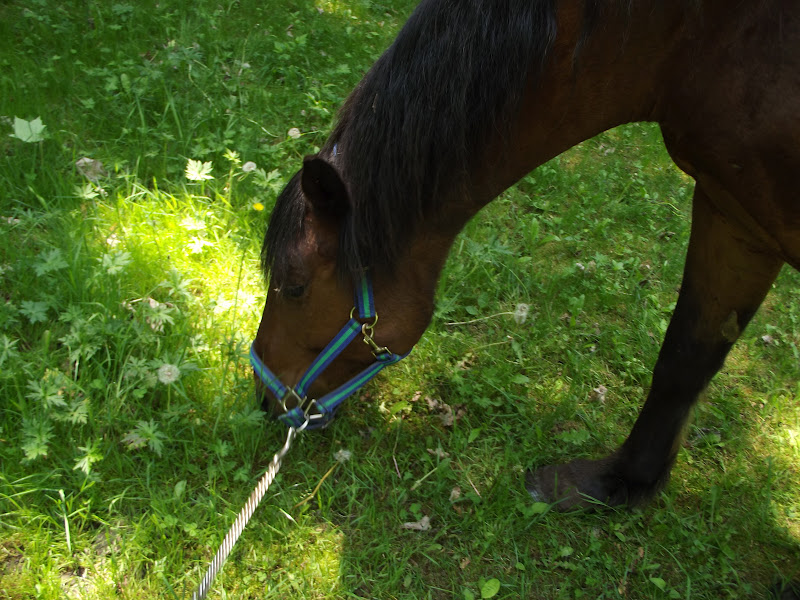
 Here is my trusty lawnmower, Pepper, in the sun,


 and in the shade. As well as feeding him hay, I usually hand-graze him for about an hour a day since we don't have any pasture for him, and he likes to keep our lawns cut.


 Wow! He looked up! In the whole hour, he will maybe look up 3 or 4 times.  He takes his job very seriously.  Horses can chew and swallow at the same time, I guess, because he just chews non-stop and somehow the grass gets into his tummy.


 "Hay, I want this blade of grass over here."  He's usually pretty good about not trying to drag me around but sometimes something is just irresistible.  Note the big knot in his lead at the bottom of the page.  A number of years ago, he broke the tough nylon lead  when someone tied him up.  Yup, just snapped it.  After that, I spent some time teaching him to stand quietly when he was tied and not freak out if he felt pressure on his halter.  Now, I rarely have to tie him up anyway since he is on his lead when he is outside of his yard, and he stands quietly in his yard if I am grooming him or working on his feet.  When he broke his lead, I thought I might as well just knot it together instead of buying a new one for him to break. And it's still holding together after quite a few years.


I thought I would include several pictures to give you a real sense of our outing. Not much action, but a very relaxing hour spent with my four-legged friend.

Thursday, May 24, 2012

Jack-in-the-Pulpit, False Solomon's Seal

 The Jack-in-the-pulpit is an interesting native plant with its striped capsule and curved hood.  It lives in hardwood forests and grows to a height of anywhere from 7" to 2'.  It will transplant successfully as long as you take a good chunk of soil with the bulb and plant it in loamy soil in a shady location with medium moisture. Very hardy to zone 2.


 False Solomon seal has clusters of small white flowers that later produce red berries.  It grows to about 2' high and prefers partial-shade.  It will tolerate poor soil, and it can be invasive as it spreads by underground roots. 


 True Solomon's seal has clusters of bell-shaped hanging flowers which are mildly fragrant.  Bumblebees like it.  It's a very tough plant and can handle quite a bit of sun, although it's preference is part-shade with loamy soil.  Also can be invasive.


 It makes a good groundcover for difficult areas as it can handle being quite dry.


On a hot day, it's always refreshing to see a patch of ferns.  These are possibly wood ferns, but I need to spend some time comparing them to the pictures on Ontario Ferns to get a proper identification.
All the above plants are native to  Eastern Ontario.

Tuesday, May 22, 2012

Ornamental Onion


 The ornamental onions are blooming giving the little green bees something to feed on.  Although they prefer full sun, I have some onions growing in part-shade and even some in shade. Because the bulbs are overcrowded, these flowers, at 4" across, aren't as big as they can get. They are a really easy plant to grow and they fill in the blooming gap between the other spring bulbs and most perennials.  Deer don't normally eat them so that's another plus. Colours are restricted to purple, pink and white . Very hardy -zone 2.


 A purple verbascum (related to our wild mullen).  I would say it is a somewhat disappointing plant in that the stems are very floppy.  It would do best in full sun with loamy soil- neither of which this plant is getting because  I don't like it enough to give it prime real estate in my garden. But in spite of the neglect, it keeps coming back so it's pretty tough.  It's a biennial.


 The center is quite interesting to look at though with its fuzzy black and yellow stamens.


 The first iris of the season.


 A tree peony just beginning to open.  It is borderline hardy here (zone 4) and can only manage to grow to about 2 1/2 ' high.  The few flowers that it produces are quite beautiful when they open, but, if the weather is hot, they quickly wilt.  Right now it's pretty warm outside so the flowers may not last long this year.


Lots of cloud shapes after the rain we had last night.  We needed the rain so that was good, but now the mosquitoes are out in full force.  They should moderate in a few days.

Friday, May 18, 2012

Baltimore Oriole


Usually the oriole's are high in the treetops, but this morning a male oriole was in a hawthorn bush and I was able to get some pictures.  Click on the pics for a full view.


 I like the way his tail is fanned out.


 I don't know what he is eating - either insects or nectar.  He stayed on the bush for a while pecking at something.


The mourning dove posed very obligingly while I took a shot. The delicate markings aren't flashy like the oriole's but they are still very attractive.