Showing posts with label perennials. Show all posts

Saturday, June 13, 2026

A Story -"Abundance and Scarcity" - White Native Wildflowers Late Spring - Daisy, Yarrow, Solomon's Seal

 Big brother Sam debated whether the next block on his tower would be blue or red. Just as his hand reached for the blue block, little brother Jacob toddled over and send the whole stack flying.

"Aargh!" cried Sam. "Don't do that!"

Grandma, who was nearby, swept up Jacob and asked Sam if he would like her to read the book on construction machines. Sam's anger dissipated and he clambered up on the couch beside Grandma ready to hear about giant dump trucks and complicated paving machines. Grandma settled Jacob on the floor by her feet with a toy with lots of knobs, and musical sounds.

At bedtime, Mom asked Sam if he wanted to sing a lullaby to Jacob with her. Sam gave Jacob a hug and a kiss, and after the toddler was in his bed, Sam joined Mom as they sang a soft song for Jacob.

After Jacob fell asleep, Dad asked Sam if he wanted to go the petting zoo the following day. 

"Yes!" Sam squealed. "I want to feed the goats again."


Kevin was trying to draw a picture of an airplane. It was almost finished. It just needed another wing when younger brother Maverick wandered over, grabbed the paper and tore it half.  Then he started to chew on the corner of the page.  Kevin yelled at him but Maverick just continued. Finally Kevin, smacked his brother on the back.

"Why is Maverick crying? Did you hit him again?" Mom shouted angrily from the kitchen.  "Go to your room!"

Kevin stomped to his room where he brooded about ripping apart Maverick's favourite stuffy .


When Sam got married, Jacob was his best man. They both worked in the same town and often got together for a game of golf. Family barbecues with little cousins playing together were anticipated.

When Kevin turned eighteen, he left home.  He went up north and got work in the oil fields. He only saw Maverick at Christmas and even then they kept their distance. Kevin didn't anticipate ever getting married.  Too much hassle. And who wanted kids? Just an expensive pain in the butt.  A good drink with his work buddies was all he needed. 


I have always loved the native daisies. So bright and cheerful.  Here they are in a scruffier part of the property beside the parking area for our cars. I mowed the grass around them but left this patch so I can enjoy their sunny beauty.  When they finish blooming, I will mow them down and next spring they will come up again, strong and dependable.


I started a small rock garden. When I was mowing the grass, I noticed some native yarrow in the lawn. I dug some up and planted it in the rock garden where it will happily grow in a dry environment. Butterflies enjoy the little white flowers of the yarrow. I also like the feathery bright green leaves. All the plants in the rock garden naturally spread so over time they will fill in all the bare spots between the rocks. I'm waiting for some purple campanula carpatica that I started from seed to get big enough to transplant into the rock garden. I have some rock cress, some hens and chicks, some sedum - short and tall- already planted.


Solomon's seal has a lovely structure to it. The stems are gracefully arched and the leaves are glossy all through the growing season.   It prefers a moist shady spot but is pretty tough. It is best planted where it has room to spread and can form a nice big clump. Hummingbirds and bumblebees like the flowers. Later in the summer it will make dark blue inedible berries. After a frost, the leaves will turn yellow but still stay on the stem for quite a while.


Saturday, May 30, 2026

A Story - "Legacy" and Petunias

 A Story

"A hundred and fifty years ago, Mrs. Marshall and her husband moved to their undeveloped land. They worked hard and managed to turn it into a sufficient farm. Mrs. Marshall had brought with her, from England, a rooted shoot of purple lilac and one of white lilac. She planted them near the house so she would be able to enjoy their fragrance.

Last week, Fiona attended the funeral of her aunt. It was a tense affair as the eulogies were forced and no one really had anything very positive to say about her. Fiona had found her to be an abrasive woman, who liked to monopolize  conversations and was critical of just about everything. She only came to the funeral to support her cousin who suffered from anxiety and was feeling overwhelmed at the prospect of settling the complicated estate. It was sad that her aunt's legacy was just more stress for her daughter.

Driving home, feeling rather down, Fiona turned on to the road where the Marshalls had lived so many years ago. Hundreds, if not thousands, of lilac bushes were in bloom in a profusion of pastel beauty. House after house had lilacs on their property. It felt like being in a Thomas Kinkade painting. It was impossible not to smile and feel happy in the joyful landscape.


Mrs. Marshall's legacy would bless people for a long time to come."


Petunias are a popular plant sold in the spring, especially in hanging baskets.


I was looking for an old-fashioned purple because I like their spicy scent.  Only the purple ones are fragrant, and the newer Wave petunias, while very floriferous and less apt to get leggy, do not have scent.

After I bought this basket, I found an all purple basket which I was happy about.  The other day, it was very windy and I brought the two baskets inside to keep them from being knocked around. The lovely scent wafted through the main part of the house. So nice.

My petunias will get leggy and bloom less in the heat of the summer.  To keep the baskets looking better, I will gradually prune them back. Every four or five days starting now (beginning of June), I will pinch a few stems back to about 4". Over time the whole basket will  be pruned but the pruning will be hardly noticeable. Using this technique, I can usually keep petunias looking decent into August. 

Of course, the newer varieties  have a tidier habit so they're a good option with less work.

Petunias are heavy feeders and need to be fertilized every week or two with a liquid fertilizer. They like to be in full sun.

I dead head every day and that also helps with getting more blooms. The whole blossom including the green sepals at the base of the flower, not just the petals, should be pinched off.


This fun petunia is called Starry Night. It's the first time I have seen a petunia with this sprinkled pattern.  Reminds me of fireworks.  It is not a new variety, just new to me.

It's an attractive magenta which isn't a common colour for petunias.

 I'm not sure what it's growing habit will be like but I can pinch it back if I have to. 

Monday, May 18, 2026

A Story - "Habitat" -Vinca (Periwinkle) and Changing Views of the Bay

A Story

Habitat

Perched on the side of the half-barrel planter filled with colourful pansies, the robin surveyed the front yard. He had a clear view all the way to the stand of lilacs that bordered the trees where he and his mate had built a nest.


Later, Sheryl noticed him and his mate poking at the front lawn finding worms and other insects. It made her happy to see them comfortable in their environment. It helped her to feel at home.  She missed the birds that she knew at her old home but this robin pair would be the beginning of new relationships.

On her usual woodland path walk, she found a large patch of wild columbine with red and yellow flowers.  They were a happy surprise.  She had tried in the past to grow columbine and hadn't had success. Here a whole swath of them were thriving in this unique habitat. 


Would she thrive in her new habitat? It would be an adjustment. Some things missed, some things gained.

 She could learn from the robins. They were content wherever they were, finding nesting spots in forests, or on a porch light in the suburbs.  Always with a cheerful song and never a bully to other birds.

Sheryl promised herself that she would start each morning watching for the robins, and opening her heart to her new life.


Vinca (periwinkle) can be an attractive groundcover in shady areas but it is aggressive. It should be planted where it can be contained and where it won't go over to the neighbours or invade a woodland area.  This patch came with the property.


The flowers are pretty at a time of year when not much else is blooming.


The bay is always changing.  Interesting patterns on the water even though the sky was just clear with no clouds.


At this time of year, we get lovely sunsets.


The dark blue of the water stands out well against the yellow green of the new leaves.

Wednesday, May 6, 2026

A Story - "Ripples" and Wild Violets

 A Story

Ripples

The fisherman, by the side of the lake,  reeled in his line and stowed his tackle. Glancing back at the water, he smiled at its smooth surface.  He picked up a flat stone and expertly sent it skipping  over the water, each tap making gentle  circles of wake.

The noisy teenagers, excited by the thrill of jumping off the bridge, took turns plunging into the water.  Some good divers hardly rippled the surface;  others cannonballed with maximum splash making waves that shocked the fish.

Under the ocean, far from eyes, magma filled a hidden chamber increasing pressure on the rock. Suddenly  it exploded with volcanic force sending a tsunami wave ten meters high crashing into coastal towns.

Her words dropped into the water of his heart, triggering expanding rings of pulsating love.


On the path down the hill behind our house, lots of wild violets are blooming.  They are so pretty. So much lovely colour without an ounce of work!


These little beauties are a source of pollen for the bees when there aren't many other flowers blooming.


This shows just a portion of the violet patch. Violets can be planted in the garden but, as is evident here, they can spread a lot. An out of the way spot that gets partial shade would be suitable.


Tuesday, January 20, 2026

A Story - "Prepared" and Perennials for Alkaline Soil - Phlox, Yarrow, Centaurea, Asters , Dianthus, Lilac

 A Story

Prepared

It all started with the Covid pandemic. Dan didn't just go down a rabbit hole.  He went down a mineshaft. The world became a scary, unpredictable place to him. The Youtubers that attracted him fueled his anxiety. Soon he was stocking up on food to feed them for five years.  He took most of his money out of the bank, just leaving enough to pay the regular bills.  After much nail-biting research, he decided to buy silver rather than gold. He built a secret storage space in the basement with a bookcase in front to disguise it and stored the silver in it.  His fear of dangerous substances in food made eating precarious and he began to lose significant weight.

His wife, Gloria, who didn't share his world view, felt him drifting away into his delusional world. He got angry when she questioned his decisions and finally she gave up trying to reason with him. He was sure something awful was about to happen.

Turns out Dan was right. One day when he was out buying more supplies, Gloria raided his silver cache and disappeared, ready to start a new life.


I am thinking about my new garden.  My old garden had clay soil on the acidic side which was good for lots of plants.  However, I didn't have many full sun locations.  In my new home, I will have lots of sun but the soil is on a limestone base so it will be alkali. I had originally wanted some roses but they like rich acidic soil which is not  what I have here.  However, phlox should grow here so I will get a couple of them in the spring.


Yarrow will be perfectly happy in the poorer soil. It will be less likely to flop over because the garden will be in full sun and the soil is light so it will be on the dry side.


I ordered a couple of asters - one purple, one magenta.  They are very tough and are great pollinators late in the season.


Centaurea prefers alkaline soil and full sun so I'm hoping for a good show with that. Easy to grow and a hardy perennial.

Also on my list is dianthus. I ordered a short bushy type and I plan on starting some carnations. I gave up trying to grow dianthus at my old garden but perhaps they will do well here. I really like the cinnamon scent of carnations.

Lilacs do well almost anywhere that's sunny and where the soil isn't too rich. They prefer alkaline soil over acidic, but they can grow in either.  I already have a couple of nice bushes  on this property and judging by the dried seed pods, the bushes  bloomed well last year.  

It will be an adventure to begin a new garden. 

Thursday, October 23, 2025

A Story - "Pick-axe Hard" - Red Leaves and Pickaxe for Loosening Hard Soil

A Story

Pick-axe Hard

"It had been a dry summer and the untended garden space had solidified into unyielding hardpan.  

Carol's mother, Margaret, lived overseas, far from family.  She stubbornly refused to move closer.

A regular shovel wasn't going to make much headway with the garden soil.  It called for serious action. A pick-axe would be needed.

 Margaret wandered around her house, dusting old photographs, rearranging decorative items bought years ago.

The pick-axe easily dug into the earth.  The heavy sharp point loosened the soil and any interfering rocks.  

The heart attack that landed Margaret in the hospital had come without warning. Painful and earthquaking.

The blade of the pick-axe dug a wider swath and prepared the flower bed for the spring bulbs.

After Margaret was stable, Carol made arrangements for her to come to her home.

In May, the daffodils sprouted and bloomed their cheerful yellow trumpets.

Margaret sat in a garden chair and couldn't help enjoying the daffodils. When her granddaughter came to visit, she drew her grandmother a picture of the daffodils with a heart above her signature.  Their relationship was blossoming."


When confronted with very hard soil, I usually use a pick-axe to loosen it up. Because a pick-axe is fairly heavy, I don't have to lift it much above the soil surface, only 8-10", for it to easily go into the soil. I start by digging with the sharp pointed end, and then continue with the blade end. I find it much easier than trying to dig the hard soil with a shovel or a garden fork.

A pick-axe is also great for grubbing out shrubs and small trees.  The blade is powerful enough to cut through the roots and then I can pull up the whole plant so it's less likely to reshoot. The pick-axe is not a fancy high tech or new tool but it is very useful.

I planted my daffodils and will be happy to see them next spring.

Saturday, July 26, 2025

A Story- "Nature's Friendship" and Coneflower, Sweet Pea, Bicolour Phlox, Lily, Pink Polka Dot.

A Story 

Nature's Friendship

After a last word of encouragement to the dependable perennials, she gazed round the full view of the gardens.  It made her smile to know that her drops of sweat had soaked into the soil.  Something of her would still be here.  A hummingbird whizzed by on its way to the feeder.  The different birds who had nested on her property and raised their families would be part of her legacy.  The next generation would know to come back to this haven.

She leaned her head back and admired the trees that had grown so tall over the years.  They had sheltered the house in winter, cooled it in summer. The wind in their leaves had whispered sweet songs to her.

But it was okay to move on.  It felt right to start a new chapter.  She walked over to her car.  As she pulled out of the driveway,  she prayed that the new owners would be blessed with many happy moments.


 All the echinacea flowers from the center to the right of the photo are on one plant. I've never had so many blooms on one plant - I counted at least 15 flowers and buds.


Some lovely fragrant sweet peas that I grew from seeds I saved last summer.  So many of the seeds germinated that the plants are rather crowded in the pot.  That means each plant has fewer flowers but it doesn't matter.  They still smell lovely.


This is all one plant. It was originally all bi-colour but now some stems are solid.  I like the combination of the different stems. The solid pink flowers match perfectly with the bi-colour flowers. Phlox has such a wonderful fragrance.  It's one of my favourite scented flowers.


I also really like the fragrance of lilies.  Some people find it overpowering but I enjoy it. Lilies are a dependable plants as long as you aren't plagued by red lily beetles.  I used to have trouble with them but I started inspecting the plants in May and getting rid of any beetles I saw and after a few years I was no longer troubled by them. I just squashed the beetles.  With beetles, I find the best way to catch them is to put one hand, palm up, under the leaf with the beetle and then try to trap the beetle with your other hand.  Usually the beetle will suddenly drop off the leaf but it will fall into the hand below.


Three pink polka dot plants that I started in spring  2024 and overwintered last winter in the basement.  They are in a nine inch pot and add a nice pop of colour in a part-shade spot that tends to dry out. I water fairly regularly but they can stand some dryness.  They can be  an alternative to coleus.

Thursday, July 3, 2025

A Story - "When Baby Came" - Calla Lily, Native Black-eyed Susan, Astrantia, Hostas and Cherry Bell Campanula, Bridging colours, Aggressive Purple-flowering Maple.

A Story

When Baby Came

 Lisa sighed gently as Peter brushed her hair, stroke after stroke. His hands tickled her neck as he gathered her hair together to make a ponytail.  He playfully swung her hair and then kissed her on the cheek.  She turned to him, and drew him into a full kiss. They had always been deeply in love but now that she was pregnant, they felt even closer. Peter rested his hand lightly on her swollen belly and smiled when he felt the baby's foot pressing outwardly. They were already connecting.

A few weeks later, Lisa went into labour.  Peter, who had attended pre-natal classes with her, knew to massage her back. He sang her favourite songs and wiped her brow with a cool cloth. He told her how much he loved her and how special it was to have a baby with her. When she was finally delivering, he held her hand and never flinched when she squeezed with all her might. Lisa was so thankful to have such a devoted husband.

Baby made a grand entrance, crying heartily and turning a bright rose red. Lisa cuddled her and laughed at her comical face.  Peter, on the other hand, stared at Baby mesmerized, totally enraptured with her.

That was the beginning of the competition between Lisa and Baby.


The summer before last I got these calla lily bulbs for free at the end of the season in August.  I potted them up and they grew a bit before the frost.  I overwintered them in their pot inside, basically just neglected them in the basement.  Last summer, I put the pot outside and they grew nice leaves but no flowers. Finally this summer, I have blooms.  Very pretty and worth the wait. They like a sunny location with ample moisture in the growing season.


Gardening is always full of surprises.  This year  three native rudbeckia (hirta) have popped up around the garden. They are a biennial plant unlike the usual perennial rudbeckia (goldstrum).  Their leaves are narrow and hairy. I guess some bird dropped their seeds in our yard. I'm enjoying having them.


Astrantia is such an unusual flower - spiky yet soft. The white ones have subtle colour variations with touches of green and pink here and there. They form a nice big clump but do not wander.  They prefer a half-shade location and adequate moisture.  A mulch around them to keep the soil from drying out is preferable.


Some of my favourite hostas, especially the green one with buttery yellow centres. I don't remember what varieties they are.  In front of them are some cherry-bell campanula which for some reason decided to make a nice ground cover this year in an area that I have struggled to find a plant for.  Campanulas in general like sun but also adequate moisture. These ones are flopping because they are not in full sun. However, they are growing well because the soil is not drying out.


To transition from the hot orange campion to the cool pink lily, I planted in a couple of miniature red roses.  The red serves as a bridge colour.


Purple-flowering maple has attractive flowers and will later make red raspberry-like fruit.  It is native to my area (zone 4).  It makes a shrub up to 5' tall. Sounds nice? Not really.  It is very aggressive and I would gladly do without it.  I spend considerable time trying to root it out of my gardens. It is sometimes sold as a garden plant  but it is a real thug. I didn't plant it in my yard - it was already here as it is a native plant. The bees like it though and birds will eat the edible, but not tasty, fruit.

Sunday, April 6, 2025

A Story - "One Way to Get Paid for a Painting" and Snowdrops, Gerbera Daisy, and Vegetables for My Eyes

A Story

One Way to Get Paid for a Painting

Humming a cheery tune, Rebecca sauntered over to her photography studio that was tucked into her backyard. The sun had finally chased away the rainy weather and she couldn't wait to get going on her latest project.

But when she got to the door, she realized that something was very wrong.  The door wasn't fully closed. Apprehensively, she listened with prickling ears and when she didn't hear anything, she gingerly nudged the door open. No one was there, but someone had definitely been there. Several pieces of expensive equipment were gone. Her fear transformed to anger and frustration.  Gritting her teeth, she took out her phone to call the police and the insurance company.

As she spoke to her insurance agent listing what items had been taken, she glanced around the studio, and suddenly she smiled and gave a little giggle.

The thief had stolen her acrylic landscape painting that she had never been able to sell at any of her shows.
She wished the thief luck trying to sell it on. 


After a long dull winter, there is nothing sweeter than seeing the little snowdrops.  This little patch was under a few inches of snow one day, the next day after some warmth, they were uncovered, already blooming.  Amazing. Snowdrops are very hardy and will slowly spread.  So far nothing has been eating them unlike the crocuses that chipmunks like. This patch is a double variety which you can't really see unless you tip the bloom up. 


Another gerbera daisy bloomed. This is the third one out of the six that I have been over wintering in the basement that sent up a flower shoot. All six plants have survived.  I kept them barely moist.  They look scraggly right now but they will perk right up when it's warm enough to put them outside.


Because macular degeneration runs in my family, I am making a more concerted effort to eat food every day that contain lutein and zeaxanthin, two nutrients that are suppose to help keep the macula healthy. In general, dark leafy greens, orange and yellow vegetables and fruits contain lutein and zeaxanthin.  So in my garden I will include beets (for the tops that I eat as greens), lettuce, peppers (Just Sweet in the photo), squash (butternut,  yellow and green zucchinis), cucumbers, broccoli, and hopefully cantaloupe.   Other vegetables that are good but that I can't grow in my garden are corn and sweet potatoes. 

Friday, March 14, 2025

A Poem - "Goodbye" and Red Hypoestes and Improved Ant Bait

 A Poem

Goodbye

 Goodbye my dear mustang,

My rugged bay pony built to withstand wind and snow

Always mindful of the need to survive.


Your mellow greetings still linger in the air,

Your rich throaty murmurings sing to my heart.


Memories of your beauty will always wave to me:

Your movement, your strength, your agility.


The little flycatchers will wonder where you've gone.

The robins will miss your shed fur for their nests.


My life is forever changed because of you.

Your life resounds in rippled waves across my world.


This red hypoestes (pink polka dot plant) has stayed nice and small over the winter.  Last summer it was on the back deck where it grew to about 10" tall.  I gave it a good prune and it kept its small form while it was on the cool windowsill for the winter. I'll put it in a bigger pot for the summer and it can be outside in a semi-shade location.


Every spring we have ants of various sizes.  I read somewhere that ants like trillium plants and we have lots of those so there are just a lot of ants in our environment.  Over the years, I have used borax/sugar mixes to keep them in check but last year I came across a brilliant improvement to my ant bait. The secret is a piece of Eggo waffle. In the picture, you can see that I took a plastic container and poked some holes near the brim.

Next I put a piece of Eggo waffle on the lid and pour over my equal parts borax/sugar mix that I have dissolved in some hot water.  Put the container bottom back on the lid. The waffle is like a sponge and the ants are happy to break off a little piece of the sweet treat to take home to the nest. Every so often add more borax/sugar solution to the waffle.

I might add that some ants prefer protein so peanut butter is a better bait for them, but my ants like sugar. 
You have to experiment to see what they like.


Wednesday, January 15, 2025

A Story - "The Gourmet's Wine" and Kalanchoe in January

A Story

The Gourmet's Wine

Every weekend Vivienne invited friends over for a gourmet meal.  Her menus followed the Mediteranean diet.  Desserts were fresh fruit.  She was pleased that she was feeding her guests healthy food.  She always served organic wine from a small vineyard.  No beer, no hard liquor, and, definitely, no soft drinks.

During the week, she bought and tasted various specialty wines so she could determine the perfect pairing for the food.

When she began to feel ill, she saw her doctor.  The shocking diagnosis was cirrhosis of the liver.

"Alcohol is alcohol no matter how pretty the packaging," the doctor said sadly. 


Kalanchoe can bring a bright pop of colour to the dull days of January.  The blooms will last for weeks, and sometimes months.  They like a bright window and not too much water as they are succulents.


To get them to rebloom after their rest period during the summer months, they need to have at least 12 hours of darkness each day.  I put mine on the windowsill and draw a heavy curtain across so that the light from the inside of the house is blocked from the plant.  They don't mind a chilly windowsill. As our days in zone 4 naturally get shorter in the fall, the kalanchoe get the required amount of darkness. They usually set buds in December and are blooming in January.  I give them a bit of fertilizer every 2 or 3 weeks when they are blooming.

Kalanchoe are super easy to propogate.  Simply take a piece of stem - 3-4" long, strip off lower leaves and plant in some soil.  This works best in the spring and summer. If plants are getting too leggy, just prune them back to the size you want and they will send out new branching shoots.

Wednesday, December 11, 2024

A Story - "Horse Healer" and December Blooming Gerbera Daisies

 A Story

The Horse Healer

When Kelly bought Buster, she knew he had issues so she hired a good horse trainer.  Over time, Buster learned to trust Kelly and the trainer but he didn't like others getting in his space.

One day, a woman horse healer came by.

"You're a good boy, Buster.  I am taking away all your hurt from the past."

Buster stuck his head out over the stall, ears forward, sniffing curiously.

Kelly was impressed.  Maybe this woman was healing Buster's emotional wounds.

Later, Buster remembered the lovely scent of the healer's shampoo - floral, hay, sweet clover.

Couldn't stand the woman.


Last summer I bought some gerbera daisies when the plants went on sale. I left them in their pots and grew them on my part-sun deck.  They grew well and bloomed repeatedly. I read on the Internet that they are perennials in mild climates and so I decided to try to over winter them in my basement which is cool and dry. I brought them in in September and only watered them very lightly. In fact, so lightly that I thought I had killed them all because their leaves went yellow and crispy. But when I checked carefully, I could see they were still barely alive.  Then I accidentally watered them more than usual and suddenly green leaves popped up as well as two flower stems. 


I brought up the two plants with flower stems to the main floor so that they would get some heat and light.

Now I have two lovely flowers to enjoy in the dark days of December.  The other pots did not send out flower stems but they are still growing very slowly in their low light, dry environment of the basement. I am trying to give them a rest period during the winter.  In April, I will put them in bright light, give them a feed and I should have some nice flowers by the end of May.

It is important that they not get too much water in the rest period or they will rot, but once they are actively growing regular watering is good. They will make more than one crown in the summer and so you can easily divided the plants. They prefer full sun but mine grew fine in morning sun. They come in lots of vibrant colours and make a lovely addition to pots or garden beds. I didn't have any trouble with insect pests.


Saturday, October 26, 2024

A Story- "The Wolf" and Coleus, Pink-Polka-Dot plant, Geraniums


 A Story

The Wolf

The sheep saw the wolf tiptoeing around the perimeter of the field but they unsuspectingly kept grazing.

Craftily, the wolf plotted his moves but he'd wait for dusk.

Suddenly, a flurry of white and black rocketed into the field scaring the sheep.  They ran, hearts thumping, this way, then the other.  The dog raced in arcs, driving them forward.  The sheep arrived at the pen, hardly knowing how they got there, panting with fear.

The sheep huddled together, worried about the dog.  But he was gone.  They sighed in relief.

They didn't see the wolf slinking off into the distance.


Last spring I started some coleus from seed.  I always find that coleus is slow to grow at first but quite a few of the seeds germinated and I put them together in a large pot on the back deck where they got morning sun.  I didn't pay much attention to them but as the summer progressed and they grew bigger, I started to really enjoy their colourful leaves. It seemed a shame that soon the frost would kill them and that would be the end of them.  I decided to take some cuttings to overwinter in the dining room.
I cut shoots about 4" long and dipped the ends in rooting hormone.  I was feeling cheap and decided to just plant them in 4" pots( reused) in garden soil instead of buying potting mix.  In a week or so, they had all rooted. I'm really pleased that it worked so well.  Because they don't need full sun, they will be fine on a table set back a couple of feet from the window.  In the spring, I will pot them into bigger pots and give them a good pinch so that they branch out more.


It's such a pretty collection of colour.

   I also started some pink-polka dot plants last spring.  This one (actually two) is a red variety. It was much larger but I gave it a real prune and so it's a manageable size again.  I read that pink-polka dots are a short-lived perennial and sometimes die after they have bloomed.  The pink ones I grew, which got to about 12" tall, were starting to bloom.  Again it seemed a waste, after starting them from seed, to just say goodbye to them so I have taken cuttings and am trying to root them in water. Internet advisers suggest that the cuttings be potted in soil when the roots are 2" long.  It's only been a week and no sign of roots yet but I do see some swelling near nodes so I guess the roots will come out soon.  I change the water every 2 days.
I bought these three geraniums on sale at the very end of the bedding plant season from the grocery store.  I only paid .99c each.  I didn't feel like potting them up so I just kept them limping along in the original pots. In February, I will start fertilizing them and get them going more vigorously and then in April/May I can take some cuttings.  I'll pot up the original plants into bigger pots.  

I tried to take some cuttings from larger geranium plants I had in the garden in September but they didn't root even though I used rooting hormone.  I had good success taking cuttings in the spring so I guess with geraniums the season is important. 

Tuesday, June 25, 2024

A Story - "Drone Flight" and Minnie Pearl Phlox, Evening Primrose, Wild Daisy, Mauve Clematis

A Story


Flying over the Icelandic moonscape, the drone smoothly closed in on the volcano.  At a safe distance, the operator took zoom photos of the lava flows, the crater.  Toxic gases drifted erratically threatening the lungs of the oblivious tourists lounging in the mineral waters of the Blue Lagoon a few miles away.  South of the volcano, Grindavik valiantly tried to hold the lava back with huge earth berms but, in a couple of spots, the black lava dripped ominously over the walls.

The drone's battery became low.  The operator regretfully terminated the dramatic flight over Iceland from his Colorado office.


Minnie Pearl phlox is an early blooming, shorter phlox. It helps to bridge the gap between spring and summer flowers blooming in the middle of June. It's not always easy to find but it is hardy and super reliable.

These evening primrose were initially given to me about forty years ago.  I have divided it and moved it around and enjoyed it every June.  It is somewhat aggressive so it needs to be planted where it can be managed with other strong growers.  If it's planted at the edge of the garden, the lawn mower can keep it in check. In the fall, the leaves turn a lovely dark red. It blooms best in full sun but will still give you plenty of colour in a shadier location.

The native daisies are so pretty I let a patch grow in our back lawn.


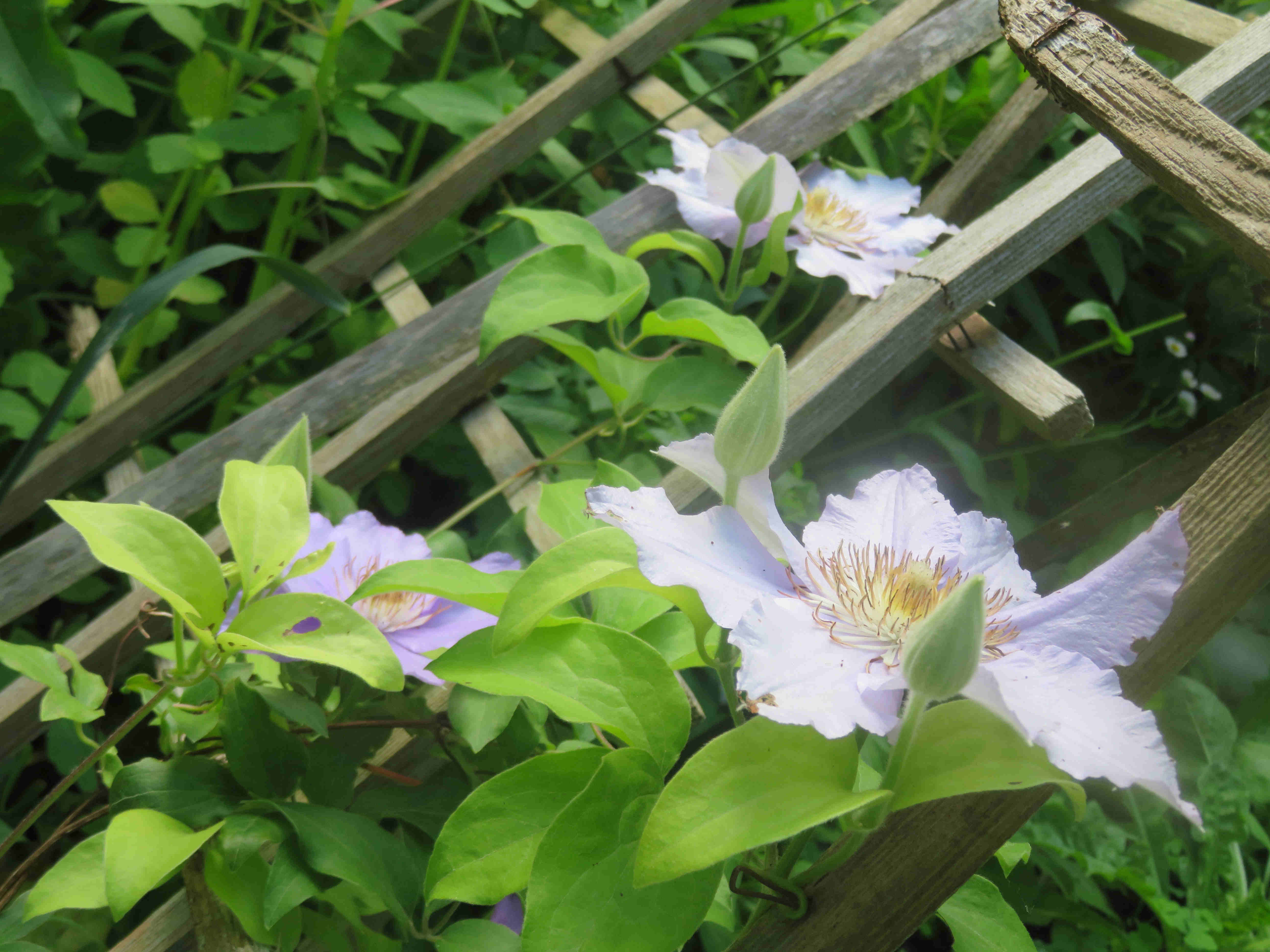
Here is a pale purple clematis I've had for several years.  Clematis like to have cool roots but sun for the top growth so you can either mulch the roots with hard scaping (rocks, patio stones, etc.) or put down wood chips.  Another way to keep the roots cool is to plant low growing, shallow rooted plants near it. I have pulmonaria near this one.

There is a lot of hoopla about how to prune clematis.  In my zone 4 garden all the clematis that survive the winter bloom on new growth.  I am very haphazard about pruning them and find they grow well no matter what I do. A little bit of slow release fertilizer in the spring will give them the nourishment they need for the season.